Revenue Integrity for Operator-Led Firms
Stop Revenue Leakage. Strengthen Follow-Through. Protect the Operating Intelligence Behind the Work.
In physical-economy firms, revenue-bearing work often moves through fragmented execution where value quietly slips away: incomplete intake, missed handoffs, unclear ownership, delayed follow-up, unbilled work, documentation gaps, billing drag, and unresolved exceptions.
We call this Ghost Margin: revenue, margin, and operating capacity already present in the business but eroded before it is fully captured.
We start by fixing that first!
Surface Revenue Exposure: Identify incomplete, delayed, unresolved, or unbilled work and quantify its potential economic significance where the evidence supports it.
Strengthen Follow-Through: Improve intake, ownership, required next actions, handoffs, exception visibility, and billing readiness.
Protect Operating Intelligence: Keep relevant context, decisions, evidence, and institutional knowledge connected to the work and under appropriate client control
Scaling physical-economy businesses don't need more software. They need a measurable capability installed around the daily they already perform. A capability they can govern, review, improve and reconstruct over time.
The form will only take 30 seconds. Or tell Mai in the lower corner to "Initiate My Pre-Engineering Org Survey."
You have a team.
You have software.
You have systems.
And you probably have more logins, dashboards, apps, forms, and subscriptions than you or your team cares to manage.
The problem is that your most valuable work still depends on memory, follow-up, field judgment, scattered data and messages, manual coordination, and experienced people who know where the real information lives.
That's where revenue leaks. That's where project risk grows. That's where valuable management time gets consumed.
AI CoFoundry installs operating capability across fragmented physical-economy environments while helping preserve the relevant operating intelligence generated through the work.
So we start where revenue, execution, documentation, follow-through, or operating intelligence is already vulnerable, not with AI tools.
Operating Intelligence Infrastructure
Hire the Function. Own the Result.
AI CoFoundry is an Operating Intelligence Infrastructure company.
We install operating capability where work is too important to miss, too complex to automate blindly, too costly to manage through manual heroics, and too valuable to surrender to unmanaged vendor intelligence layers.
We don’t build "chatbots" or deploy off-the-shelf AI tools. We install governed operating functions around defined areas of work.
A function is not a chatbot, dashboard or another app your team has to babysit.
A function is a defined area of work your business already performs such as quote follow-up, change-order capture, field-to-office handoff, billing readiness, project documentation, dispatch support, customer intake, compliance records, or operational follow-through.
We install governed AI support around that function so the work becomes more visible, measurable, fluid, consistent, reviewable, and improvable.
The function is the value. AI, automations, dashboards, prompts, models, integrations, or agents are the extensible machinery underneath the hood.
Governed Operating Functions
We design and install operating functions with defined workflows, responsibilities, permissions, safeguards, measures, escalation paths, and human-review requirements.
Layered in How Your Work Flows
The operating function works across approved systems, data, communications, and day-to-day workflows rather than requiring the business to abandon its existing operating environment.
Governed from Day One
Guardrails, approvals, audit trails, escalation rules, and human review are established according to the consequence and authority of the work.
Measured and Observable
Monitor workflow conditions, performance, aging, exceptions, and completion while preserving the relevant evidence and context required for review.
"Most AI is rented and used. Very little is commissioned, installed and operated as infrastructure. This is our difference."
No lock-in. No trapped data. No black-box dependency.




Operating Intelligence Control
Protect the Know-How Your Business Spent Decades Earning
Your company’s value is not only in your equipment, contracts, crews, customer list, or software stack.
It is also in your operating judgment:
How your estimators think
How your project managers follow up
How your field leaders read risk
How your team handles exceptions
How your company documents work
How your people know what needs attention before it becomes expensive
As more work moves through software, SaaS, automation, and AI, important operating context can become fragmented across systems or dependent on individual people and providers.
AI CoFoundry is designed to preserve your relevant operating intelligence while making your work more visible, measurable, reviewable, scalable and governable.
Your Functions
Policy-driven
Workflow-embedded
Auditable
Human reviewed where needed
No uncontrolled AI behavior.
Your Records
Unlocked across systems
Structured for review
Connected, evidence and in-context
Reconstructable within scope
Minimal trapped operating context.
Your Operating Layer
Designed around your approved work
Portable where practical
Extensible over time
Adaptable as the business changes
Optimal continuity and future choice.
Most AI increases dependency. We design for client control, continuity, and future choice.
Special Operator's Report:
The AI Most Companies Believe They Have Is Not the AI They Are Actually Operating
If you look at the surface indicators, it’s reasonable to conclude that AI adoption is largely underway. Across industries, AI tools are embedded into CRMs, ERPs, numerous SaaS platforms, and company workflows. Employees are using them daily in formal and informal SOPs, and leadership teams are actively investing in new capabilities. By most conventional measures, the transition appears to be well underway.
And in a narrow sense, that is true. Nearly nine out of ten organizations now report using AI in at least one business function, but that statistic, while accurate, conceals a more important operational reality.
What has been achieved in most organizations is not the installation of AI into the business. It is the introduction of AI into the environment. Those are not the same thing, and the difference between them explains much of what executives are now experiencing, both in terms of uneven performance and growing uncertainty.
The Difference Between Presence and Operation
When AI is introduced into a business, it tends to appear first at the edges. Individuals use it to accelerate tasks, reduce friction, or improve output quality in isolated moments. Teams begin to incorporate it into parts of their workflow. Over time, usage spreads organically (whether or not management intends).
This phase is often interpreted as success, especially in smaller and less structured orgs. It is visible, measurable to a degree, and easy to communicate internally. However, it does not fundamentally change how work flows through the organization.
AI, in this state, is present, but it is not accountable. It does not own outcomes. It does not enforce consistency. It does not create visibility across the system. And because of that, its impact remains dependent on human behavior rather than being embedded in the structure of the operation.
The data supports this distinction. While adoption has become widespread, only about one-third of organizations report that they have scaled AI into core operational workflows.
Even among those investing heavily, many are not seeing measurable enterprise-level impact. As one global executive survey summarized:
“The transition from pilots to scaled impact remains a work in progress at most organizations.”
This is not a failure of technology. It is a function of how, and where, AI is being applied.
Where the First Gap Actually Sits
From an operator’s perspective, the gap is not difficult to locate once you stop looking at tools and start looking at work flow. In most businesses, the way work is captured, validated, routed, and completed has not fundamentally changed. AI has been layered on top of existing processes, but the underlying system remains largely intact.
That is why performance improvements tend to be inconsistent. They depend on who is using the tools, how disciplined the usage is, and whether outputs are verified and acted upon in a consistent manner. One operator described it this way during a recent implementation:
“We didn’t have an AI problem. We had a consistency problem. AI just made it easier to see where things were breaking.”
That observation is consistent with what leading research is now showing. Organizations that are capturing meaningful value from AI are not simply adopting more tools. They are redesigning workflows and embedding AI into the operating model itself. In practical terms, they are shifting from assistance to accountability.
The Second Gap Forming Alongside the First
At the same time this performance gap is becoming visible, a second, less visible condition is developing in parallel.
AI is not only being introduced through formal initiatives. It is being adopted directly by the workforce, and often outside the boundaries of systems, policies, and governance structures. What begins as individual productivity quickly becomes distributed, unmanaged usage.
Recent reporting highlights how quickly this dynamic is accelerating. In many organizations, adoption is now outpacing oversight, with a significant portion of executives acknowledging that governance frameworks have not kept up.
The implication is not simply technical. It is operational.
Without visibility into how AI is being used, organizations lose clarity over how data is handled, how decisions are influenced, and how outputs enter critical workflows. What appears as incremental efficiency at the individual level can introduce ambiguity at the system level.
As one governance-focused executive put it:
“AI doesn’t just change what people can do, it changes what the organization can see.”
A Market Dividing Along Operational Lines
Taken together, these two dynamics, performance inconsistency and control ambiguity, are beginning to separate organizations into distinct groups.
On one side are those who have adopted AI as a capability that individuals can access. These organizations often see localized gains, but struggle to translate them into consistent, risk-averse, system-level performance.
On the other side are those who are treating AI as part of the operating infrastructure. These organizations are not defined by the number of tools they use, but by how work is structured, monitored, and executed across the system.
The difference is now measurable. A recent industry analysis found that the majority of financial gains from AI are concentrated in a relatively small percentage of companies that have moved beyond experimentation into operational deployment.
This is not simply a matter of maturity. It is a matter of the operating model.
Where the Signal Becomes Clear
In practice, organizations rarely arrive at this realization through a broad strategic initiative. It becomes visible in specific parts of the business where the effects of inconsistency or lack of control are easiest to observe.
On the performance side, this typically appears in the early stages of revenue flow, where intake, qualification, routing, and follow-through determine whether opportunities are captured or lost. Small inconsistencies at this stage compound quickly, often without being immediately attributable to a single cause.
On the control side, the signal appears in the growing difficulty of understanding how AI is interacting with the organization’s data, systems, and decisions. This is not primarily a policy issue. It is a visibility issue, an inability to fully account for how (and how securely) work is being augmented or influenced.
These are not separate problems. They are two manifestations of the same underlying condition: AI has been introduced to the system, but it has not yet been installed as part of the system.
The operational conclusion
The organizations that are moving ahead are not doing so by increasing access to AI. They are doing so by establishing where AI must operate with consistency, visibility, and control, and then installing it at those points.
This shift changes the role of AI within the business. It moves from being a tool that individuals use to being a capability that the organization operates. A recent governance-focused analysis captured this transition clearly:
“Governance is no longer optional; it is the lever that turns AI from an experimental tool into a sustainable competitive advantage.”
That statement reflects a broader reality. AI does not become valuable at scale until it becomes observable, measurable, and accountable within the operation itself. And for most organizations, the transition from access to capability does not begin everywhere at once. It begins where the system is already under strain, either through lost performance or limited visibility.
Those entry points tend to be consistent across industries:
-Where revenue is entering but not fully captured
-Where AI is being used but not fully governed
One exposes the cost of inconsistency. The other exposes the cost of uncertainty. Both lead to the same requirement:
"AI must move from something that is used… to something that is installed, governed, and operated as part of the business."
REVENUE INTEGRITY
Start Where Revenue-Bearing Work Is Vulnerable
Revenue Integrity
The most financially responsible first install for firms losing margin through fragmented execution.
The Revenue Integrity product domain helps identify, recover, protect, and operationalize revenue the business has already created or should be positioned to capture.
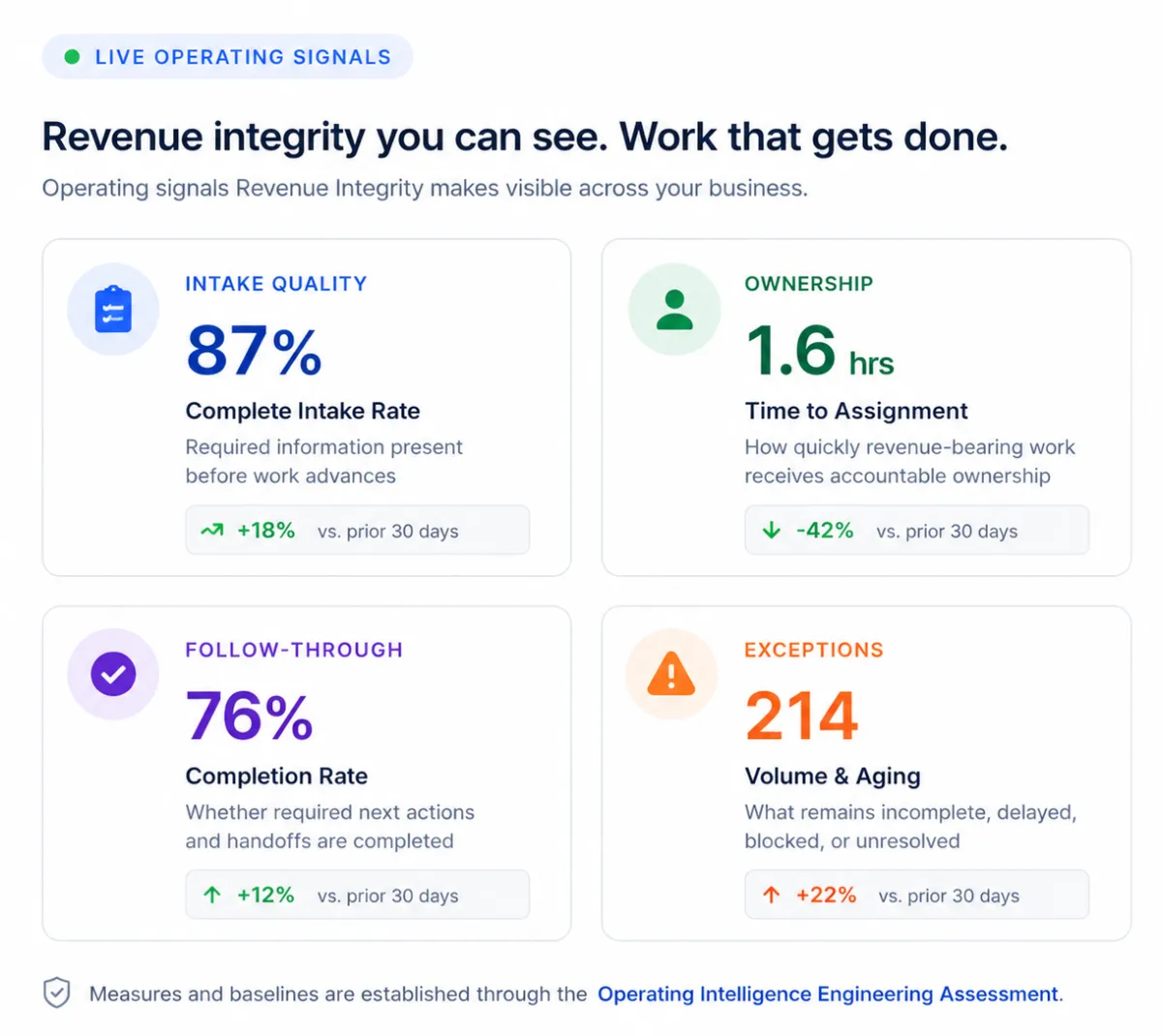
It improves the controlled completion of revenue-bearing work by making incomplete intake, unclear ownership, missing required next actions, weak follow-through, aging exceptions, and billing-readiness problems more visible and governable.
Missed or delayed quote follow-up
Open change-order exposure
Uncaptured additional work
Field-to-office handoff gaps
Billing drag
Incomplete project documentation
Slow follow-up
Operating context buried in calls, texts, emails, notes, and human memory
Work completed but not yet documented, approved, coded, billed, or escalated
Primary Outcome: More complete intake. Clearer ownership. Stronger follow-through. Better visibility into revenue and margin exposure.
Customer Communication & Notifications
Delivers timely, multi-channel updates to improve transparency and trust.
Eliminate communication gaps and reduce manual support volume. This entry function serves as your organization’s automated delivery layer, deploying the right information at the right moment.
Automate Event-Driven Alerts: Trigger instant, high-visibility notifications for critical system events such as event and activity confirmations and notifications, visit and service receipts, or security alerts without manual intervention.
Multi-Channel Reach: Orchestrates delivery across Email, SMS, Push Notifications, and Telephony ensuring 100% reach to your audience, bypassing crowded inboxes and social media.
Standardize Brand Voice: Ensures every outbound message adheres to your governed "Brand Memory," maintaining consistency in tone, language, and formatting.
Reduce Operational Friction: Drastically cuts the "Where is my...?" support burden by providing real-time, proactive status updates and follow-ups.
Foundation for Expansion: Establishes the technical "delivery spine" and customer trust necessary to transition into deeper Customer Lifecycle Orchestration.
Primary Outcome: Enhance your customer first impression and reclaim operational capacity by transforming fragmented updates into a governed, reliable notification system.
Internal Support & Helpdesk
Automates request handling and triage to eliminate operational bottlenecks.
Unburden your internal teams from repetitive requests. This workforce function structures and automates internal support workflows, ensuring issues are resolved with speed and discipline.
Standardize Request Intake: Captures and normalizes internal requests from Chat, Email, Voice or dedicated portals, ensuring all necessary data is present before reaching a human administrator.
AI-Powered Triage & Routing: Automatically identifies issue categories from IT hardware requests to HR policy questions, and routes them to the correct department with confidence-based urgency scoring.
Automate L1 Resolutions: Deploys AI agents to handle high-volume, low-complexity tasks such as password resets, basic troubleshooting, or accessing common documents.
Reduce Escalation Rate: Provides a "Monitoring and Exception" layer that surfaces only complex or high-priority issues, preserving expert bandwidth for strategic projects.
Establish Internal SLAs: Monitors performance metrics like Time-to-Resolution and First Response Time to ensure consistent internal service quality across all departments.
Primary Outcome: Scale your internal operations efficiently by converting repetitive support tasks into a governed, automated helpdesk system.
No disruptions. No downtime. No internal rebuild required.
Your business continues in-flight while your new capability is installed and hardened.
-Mai can give you more details. Give her a go.
Installation
To Get Durable Operating Capability:
Start Small. Harden. Then Scale.
We move you from manual heroics to Operating Intelligence Infrastructure via a disciplined through a disciplined engineering and installation roadmap.
Step 1 - Pre-Engineering Org. Survey
A 15–30 minute phone conversation to survey your core processes, operating structure, known bottlenecks, targets, constraints, and desired outcomes.
Step 2 - Operating Intelligence Engineering Assessment
An in-depth, preferably on-site assessment to determine readiness, define the required operating architectural fit, controls and dependencies, and establish the appropriate implementation sequence.
Step 3 - Design-Build
We design and configure the approved operating function around your workflows, systems, ownership rules, required actions, exceptions, permissions, measures, and governance.
Step 4 - Install & Test
We install the function within a live sandbox operating environment and validate integrations, controls, human oversight, exception handling, and expected behavior.
Step 5 - Commission
We place the function into governed operation with defined responsibilities, review queues, reporting, escalation paths, and measurable operating targets.
Step 6 - Harden, Operate & Maintain
We monitor real-world performance, refine and maintain the function, and expand only when operating evidence and readiness support the next step.
Packages
Every installation engagement includes Co-Learn, as well as, design-build, install & test, commission and harden steps above.
Need something different? Schedule a live call, or ask Mai (in the lower corner) about other entry AI workforce function deployments including those for regulated industries, on-prem requirements, or global rollouts. Book a conversation or ask Mai to help you think through your constraints.
Just ask Mai in the lower corner, but if you want a more human touch ask her to schedule call with one of our Co-Founders.
Start small. Prove diligently. Expand appropriately.
Why Us
Why Firms Choose AI CoFoundry
Too many AI efforts start with the tool, not the work.
We start where experienced operators start:
where money is leaking,
where follow-up too slow or inconsistent,
where documentation is incomplete,
where handoffs are breaking,
where management time is being consumed,
where systems are creating work instead of reducing it,
where the business depends too heavily on human memory, texts, inboxes, spreadsheets, or one person’s judgment.
Then we install a governed operating function around that specific operating problem.
We do not sell AI enthusiasm. We install operating capability.
Our Operating Rule
Immediate problem. Install operating capability. Measurable evidence.
Client control. Broader vision.
Operational Fit
Where We Work Best
AI CoFoundry is built for profitable, owner-operator led businesses where the work is complex, relationships are important, documentation is heavy, and operations are unforgiving.
These firms often have decades of hard-earned expertise.
They use business technology because they have to, but they do not blindly trust it because they have seen how much time, cost, and complexity it can add.
We are a strong fit when:
Revenue depends on fast, accurate, and clean execution
Work moves across field, office, estimating, project management, accounting, vendors, subcontractors, agencies, and customers
Documentation affects billing, claims, compliance, cash flow, or customer trust
Key operating knowledge lives in workflows and experienced people
Software exists, but the business still runs on manual coordination
The owner or leadership team wants more control, not more tech
Examples include:
Heavy Civil Infrastructure, Marine and Industrial Construction
For operators managing complex, high-stakes work across crews, equipment, owners, agencies, permits, inspections, mobilization, weather, field reporting, and documentation. We help improve visibility around handoffs, billing readiness, project records, open loops, and operational follow-through.
Specialty Construction & Field Services
For owner-led firms where margin depends on fast response, estimating discipline, dispatch, field execution, change-order capture, documentation quality, customer follow-up, and timely billing. We help surface missed work, unbilled work, delayed follow-up, and operating knowledge trapped across systems and people.
Architecture, Engineering & Construction Management
For professional and project-driven firms where utilization, proposal follow-up, project records, owner requests, submittals, closeout items, documentation, and billing support directly affect margin. We help reduce administrative drag while preserving judgment, review, and professional accountability.
Renewable Energy & Solar EPCs
For firms managing site assessments, interconnection, AHJ permitting, proposal follow-up, inspection coordination, customer communication, and field-service workflows. We help reduce PTO delays, missed follow-up, documentation gaps, and fragmented project handoffs.
Equipment-Intensive Logistics & Industrial Services
For businesses where equipment availability, dispatch timing, service requests, vendor coordination, maintenance records, documentation, and cross-system reconciliation affect performance. We help create clearer queues, reviewable records, exception paths, and operating visibility.
Strategic & Portfolio Fit
For portfolio companies, multi-location operators, family-office-owned businesses, and NewCos looking to build cleaner operating systems from the start. We install repeatable governed operating functions that preserve operating intelligence, improve visibility, and support governed expansion across branches, business lines, or portfolio companies.
We Don't Overwrite 50 Years of Operating Judgment. We Preserve It.
The best construction and field-service businesses are full of hard-earned knowledge that no generic AI model understands out of the box.
Your estimators, project managers, dispatchers, superintendents, coordinators, accounting staff, and senior operators already know things your software does not know.
Our job is not to pretend AI is smarter than them.
Our job is to help capture, structure, route, review, and preserve the operating context that already makes your company valuable, so the business can move faster, miss less, document better, and rely less on manual heroics.
FAQ
What Decisive Operators Ask Before They Act
If you have questions about security, data residency, models, or change management, you’re in the right place.
We’ll meet you where your stack and risk posture are today, then design-build and install the operating capability you can safely govern tomorrow.
Just chat with Mai for answers to any questions. She's eager to help!
We already have software. Why do we need this?
Because software usually stores work. It does not always make sure the right work gets captured, followed up, reviewed, documented, billed, escalated, or improved.
AI CoFoundry installs governed operating functions around your existing systems and workflows so your business can reduce manual drag, surface exceptions, and create better operating records without replacing your whole stack
Is this just another dashboard?
No.
Dashboards can be used as a measurement mechanism. These much more than dashboards. They are functions acting on and around what may be missing, stale, incomplete, delayed, unassigned, unbilled, undocumented, incomplete or ready for human review.
The goal is timely operating completion and follow-through.
Will this disrupt our field teams or project managers?
We design around current operating maturity. The first function should be valuable, visible, measurable, practical, easy to explain, tied to an existing business problem, and supportable by the client’s current operating environment.
Can AI be trusted with serious construction work?
Not blindly.
That is why our approach uses defined functions, human oversight, review rules, escalation paths, records, telemetry, and boundaries.
AI supports the work where appropriate and escalates when judgment, approval, safety, money, compliance, or customer trust is involved.
What if our data is messy?
That is normal.
Most operator-led businesses have valuable information spread across CRMs, ERPs, spreadsheets, email, texts, documents, field notes, accounting systems, scheduling tools, and people’s memory.
We do not require perfect data to start.
We select one function where the available context is good enough to create measurable value, then improve records and workflow visibility as part of the installation and hardening.
What does success look like?
Success depends on the function, but examples include:
+ Faster quote or proposal follow-up
+ Fewer missed handoffs
+ More complete intake records
+ Better change-order visibility
+ Reduced billing drag
+ Better documentation readiness
+ Less project-management administrative burden
+ More reviewable operating records
+ Clearer ownership of open loops
+ Better visibility into where revenue or time is leaking
How is this different from hiring an AI consultant or buying a point solution?
Consulting can provide advice, and point solutions can solve individual technology problems. AI CoFoundry’s product is installed operating capability.
We define the operating function, configure it across the approved environment, establish controls and evidence requirements, commission it, and measure how it performs in operation.
What does installation look like? (The 28-Day Target)
The timing depends on scope and readiness.
When an Operating Intelligence Engineering Assessment supports proceeding, installation and initial commissioning are targeted around an approved, bounded operating function. Access constraints, integrations, client participation, third-party dependencies, and validation requirements can affect the schedule.
Commissioning is followed by proof, hardening, and appropriate monitoring before expansion.
We move in 28-day target sprints.
Do we control the operating function, records, and technology environment?
Client control is central to the architecture.
Business-specific data, records, configurations, workflow decisions, permissions, and operating history are distinguished from AICF’s reusable infrastructure, methods, and intellectual property.
Specific ownership, hosting, portability, licensing, and transition rights are defined by the implemented architecture and engagement agreement. The objective is continuity, reconstructability, future choice, and no artificial lock-in.
How do you handle security, privacy, and compliance?
We meet you at your risk posture. We can operate on your cloud, in a private VPC, or within your existing tenant. Deployments include reviewable logs, policy-aware guardrails, and escalation paths appropriate to the use case.
Which models and vendors do you use?
Models and vendors are selected according to the operating requirements, security posture, cost, performance, data requirements, and approved architecture.
They are components beneath the operating function—not the product itself.
Where practical, we design for continuity and future choice as model and provider capabilities change.
What internal resourcing do we need on our side?
You provide the appropriate operating knowledge, access, decision-makers, and reviewers. We engineer and install the operating capability with your team.
You do not need to support an internal AI department to start, operate or maintain the infrastructure.
How do you measure impact?
Measurement is defined around the installed function and available evidence.
For Revenue Integrity, examples can include intake completeness, ownership and required-next-action timing, exception aging, follow-through, handoffs, billing readiness, resolution performance, and supported revenue or margin exposure.
Financial-result claims are made only when the evidence supports defensible attribution.
Serious Partners only
Serious Partners Only.
Co-Design the Future of Your Vertical.
We selectively partner with experienced operators and industry experts to develop governed operating functions for specialized physical-economy markets. Partnership structures may vary based on contribution, market opportunity, operating knowledge, and commercialization pathway.
Together, we can design-build, harden, and distribute industry-changing, governed operating functions.
Or tell Mai about your industry expertise and the operating problem or function you believe deserves attention.